

How to Start a Soft Play Business in the UK (2026 Guide)
Thinking about starting a soft play business in the UK?
It’s easy to look at a successful soft play and think it’s simple: find a building, install some equipment, sell tickets and let the customers roll in.
However, in reality, there’s a lot more to consider.
A successful soft play business needs the right location, business model, equipment and customer experience. Before making any decisions, you also need to understand your costs and what you’re committing to financially.
So, if you’re researching how to start a soft play business, here is what you need to think about before you commit to a building, a business plan or a very expensive slide.
Is a Soft Play Business Profitable?
Yes, a soft play business can be profitable. However there isn’t a magic figure that tells you whether yours will be. A small toddler play cafe with relatively low overheads has a very different financial model from a large family entertainment centre.
In summary, your income could come from admission fees, birthday parties, food and drink, memberships, private hire and holiday activities.
Then there are the costs.
First, rent, business rates, utilities, staff, insurance, cleaning, maintenance and marketing all need to be paid for. Meanwhile, soft play equipment can be another major cost.
Ultimately, the important question isn’t just how much can I charge? It’s how many customers do I realistically need on a day-to-day basis?
Don’t build your business plan around being busy every weekend.
Instead, look at quieter weekdays, school holidays, seasonal changes and your expected average customer spend. Your business needs to work beyond the occasional packed Saturday.

Before you start looking at equipment, it’s worth understanding the likely investment. Our guide to commercial soft play costs breaks down the costs involved in a commercial project, as well as including expenses that are easy to overlook.
What’s your Soft Play Business Model?
One of the biggest decisions you will make is what kind of soft play business you actually want to run.
For example, two common models are fixed venues and soft play hire. Although they can look similar from the outside, the businesses behind them are very different.
| Fixed venue | Soft play hire | |
|---|---|---|
| Initial investment | Higher | Lower |
| Premises | Required | Storage needed |
| Main income | Entry, parties, café | Hire bookings |
| Capacity | Depends on venue | Depends on equipment + availability |
| Main challenge | Overheads | Logistics |
| Best suited to | Destination businesses | Flexible/mobile operators |
Fixed Indoor Soft Play Venue
This is the traditional model, you rent or buy a permanent location and create a soft play attraction inside it.
Some examples include:
- A dedicated children’s play centre.
- A play cafe.
- A family entertainment centre.
- A farm or garden centre attraction.
- A leisure centre attraction.
The advantage is that customers come to you and you can build several revenue streams around the play area. However, this also comes with ongoing costs for rent, rates, utilities, staff and maintenance.

Research Your Local Soft Play Market.
Before signing a lease, find out whether people actually want another soft play in your area. Start by looking at existing businesses within a realistic driving distance and, more importantly, how they position themselves. After all, a gap in the market doesn’t necessarily mean there’s demand for it.
Who am I trying to attract?
Families with toddlers? Older children? Parents looking for birthday parties? Your answer will affect almost every decision you make, from the size of the equipment to your pricing and opening hours.
What are customers unhappy about?
You should also start with the reviews. In particular, are their customers complaining about cleanliness, food, or parking? Maybe the party bookings?
As a result, those complaints can help you understand what customers expect from a soft play business.
Why would they choose me?
Don’t just copy the nearest competitor because their business looks successful. Instead, work out what your version would do differently and why customers would have a reason to visit.
That could be a different age range, better parties, a strong cafe offer or simply a better overall experience.
Once you’ve identified the gap, build the business around it.
Find the Right Location
A cheap building isn’t necessarily a cheap building to turn into a soft play.
First, think about how easily families can reach you. Is there parking? Is the building near housing, schools, or other family destinations? After all, venue can have a fantastic soft play inside it, but if getting there is difficult, customers may simply choose somewhere easier.
Size:
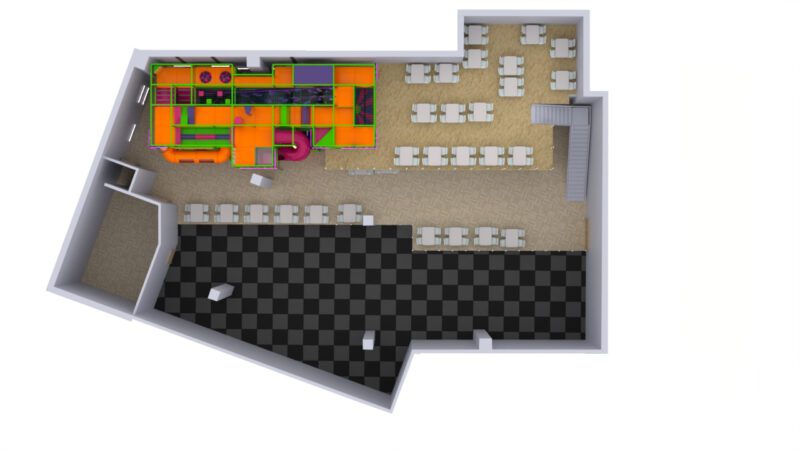
However, don’t judge a building by its total floor area. Instead, account for space needed for reception, toilets, cafe space, seating, storage and staff areas. Remember, a huge building might sound ideal, but more space also means more space to fill with customers.
Ceiling Height:
Specifically, ceiling height can have a huge impact on the type and scale of soft play you can install. For example, if you’re hoping for multiple levels, towers or larger slides, check the available height before getting too attached to a particular property.
Building Condition:
An older building may need electrical, heating, ventilation, floor or structural work done before you can think about installing the play equipment.
As a result, a property that looks cheap on paper could become considerably more expensive once you start preparing it for customers.
Accessibility:
Accessibility should be considered before the design begins, not added as an afterthought. Think about how easily families with prams and children with additional needs can enter, move around and enjoy the venue.
Most importantly, check the intended use of the property before signing anything. A change of use may require planning permission or prior approval, depending on the property and proposed use. For this reason, we recommend you check with the local planning authority before buying or leasing a property.

Create Your Soft Play Business Plan
This can be the least exciting bit, but it’s also one of the most important.
Your business plan should explain what you’re trying to build, who you’re trying to attract and how the numbers are expected to work.
Don’t build your forecast around your best possible month. Instead, build it around a realistic one.
Start with the money you need to open
Your startup budget needs to cover more than the soft play equipment.
This could include the building, deposits, professional fees, fit-out work, furniture, signage, technology and even insurance. Also the cash you’ll need to keep the business running after opening.
You don’t want to spend every penny getting the doors open and then discover you don’t have enough money to cover the first few months of bills.
Now work backwards from your customers
Once you know your average customer spend and your monthly cost. From there, you can estimate how many customers you need to break even. Then, ask yourself whether that level of footfall is realistic.
Is your capacity large enough? What happens during school holidays? What about a wet Wednesday in January?
Ultimately, those questions are much more useful than simply asking whether a soft play could make money.
Plan the Soft Play
Now you get to the fun bit.
Your equipment should be designed around your customers and your building, rather than choosing a collection of features because they look impressive.
Think about:
- Age ranges
- Capacity
- Different levels of challenge
- Visibility for parents
- Entrances and exits
- Areas for younger children
- Accessibility
- Seating
- Party areas
- The overall theme and appearance
Most importantly, the final design should be based on the space available, the target age range and how you expect customers to use it.
For example, in our recent soft play project at Clip ‘n’ Climb Colindale, the owner wanted to have easy access both on the mezzanine and the ground floor. As a result, we had to design the equipment to suit these two exit points.

Beyond the design itself, a good commercial soft play should also make sense operationally.
For example, can staff see what is happening? Can children move through it without any unnecessary bottlenecks? Can damaged areas be accessed for repair? Can staff clean it properly?
These questions matter as much as whether the slide looks good in photographs.
Understanding Safety, Insurance and Responsibilities
Running a children’s play business comes with serious responsibilities.
Therefore, health and safety law applies to businesses of all sizes, and operators need to manage risks sensibly and proportionately. HSE guidance stresses that the aim isn’t to eliminate every possible risk from children’s play, but to control genuine risks while preserving the benefits of play.
You will need to think about areas such as:
- Risk assessments
- Equipment inspections and maintenance
- Cleaning procedures
- Staff training
- First aid
- Accident reporting
- Fire safety
- Emergency procedures
- Insurance
However, don’t treat this as paperwork to sort out after opening. Instead, build it into your business planning from the start.
Choose your Equipment Manufacturer Carefully
Once you know what you want to build, you can start speaking to commercial soft play manufacturers.
Don’t compare quotes on price alone. Instead, ask what’s included: design, installation, flooring, delivery, structural work, warranty and aftercare?

You should also ask how the equipment is manufactured, what materials are used and how repairs are handled if something becomes damaged after opening.
Finally, look at previous projects rather than relying entirely on polished sales images. A manufacturer’s case studies can show you how they’ve approached different spaces, age groups and project requirements.
Launching a Soft Play Business in the UK
Once the building, equipment and operational side are ready, you can focus on opening. That said, don’t wait until opening day to start marketing. Build interest while the project is still being developed.
Share the transformation of the building. Show the design process. Introduce the team. Give people sneak peeks of the equipment. Start collecting email addresses and social followers.

Once you launch, keep track of what actually works.
Monitor your customer numbers, busiest times, average spend, party bookings, reviews and marketing enquiries.
Your original business plan is a starting point, not a sacred document.
So, Should You Start a Soft Play Business?
If you’re researching how to start a soft play business in the UK, the biggest mistake is jumping straight to the equipment. Instead, start with the business.
A soft play business can be a significant investment. However, it can also become a strong local attraction when the concept, location, finances and customer experience all work together.
The best place to start is not with the slide.
It’s with the plan.
Frequently Asked Questions
We’ve pulled together the most common things people ask us, from how we work and what to expect, to timelines, pricing, and everything in between. If you can’t find what you’re looking for, just reach out and we’ll get you sorted.
Essentially, the cost of starting a soft play business varies significantly depending on your size, location and equipment.
A permanent commercial soft play will usually require a larger initial investment than a hire business.
See our guide to commercial soft play costs for more information.
A soft play business can be profitable. However, like any business, it depends on factors such as your customer numbers, the average customer spend and operating costs.
A realistic business plan should help you work out how much customer traffic you need to break even.
There is no single minimum size for a soft play business. We usually don’t recommend a soft play size less than 500 sq.ft. Otherwise you risk having little room for different levels of challenging equipment.
Check your property and its existing use. Changing a building’s use may require planning permission or prior approval. For this reason you should check with the relevant local planning authority before committing to a property.
A commercial soft play might include slides, climbing features, crawl tunnels, obstacles and other interactive elements.
However, equipment should be designed around the space and how customers are expected to use it.
Check out our buyer’s guide for more assistance.